


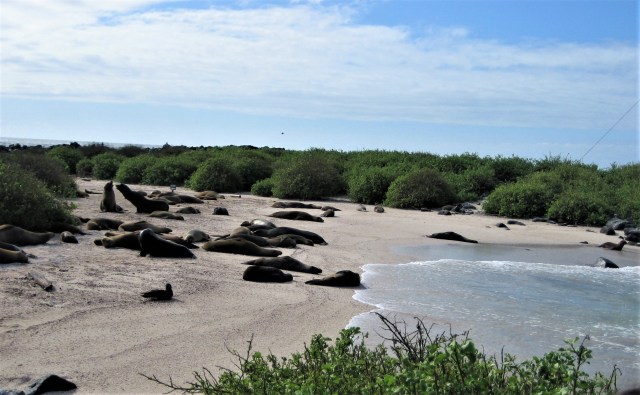
A landing at Bachas Beach on Santa Cruz Island was our first excursion on day 4 of our week-long trip with Celebrity Xpedition. We were on the beautiful shore for about two hours at low tide and able to experience the tidal pools among the lava rock, with pure and fine white sand. There were small fish everywhere, a lone pufferfish, crabs, marine iguanas sneezing salt, sea lions, blue herons, pelicans, lava herons, and one flamingo. It was lovely and hot, hot, hot.

Viewing the stars in the night sky from a boat in the middle of any ocean is something to behold. The captain turned off all the ship’s lights so we could take it all in on this perfectly clear night.

Isabella Island: Jungle Walk & Coastal Cruise

On the mother-ship for an Ecuadorian lunch, we cruised and looked for dolphins and whales, enjoying a pod of dolphins at play. Late in the day, we took another panga ride, and our group opted to look for sea turtles rather than hike on the island. We rode around the coast of Fernandina finding a few turtles, penguins, flightless cormorants (with wings 1/3 the size needed to fly), and many more birds. Dinner was served al fresco and a guest (who was a professional opera singer) was prevailed upon to sing. We listened to a magical, acapella rendition from Porgy & Bess.


Santiago Island: Pristine Grotto & Fur Seals
My new favorite was on day 6, at James Bay on Santiago Island – stunning!
We walked across the island in silence and just took in the sounds, at one-point walking right by a hawk just staring as we passed. The best was yet to come when we got to the lava flow on the other side of the island, with its tidal ponds, lava bridges, and grotto. And that’s where we found the fur seals, including pups. They were so adorable! Along with our usual array of birds and marine life, we saw oystercatchers, and, in the crystal-clear water of the grotto, there were beautiful tiny redfish and a sea turtle passing through. I could’ve stayed with the fur seals all day.
Back around the island on a black sand beach, we went snorkeling and I saw the most beautiful, blue starfish I’d ever seen, as well as pufferfish, parrotfish, anemones, and so many more I cannot ID. Others saw a white tip shark, and again, I was thankfully ignorant of its presence.


Santa Cruz Island: Lonesome George
Santa Cruz Island’s cute town of Puerto Ayora is the main center of human population (12,000) in the Islands and home to the Charles Darwin Research Station. When we visited it was also home to the most famous land tortoise in the world, Lonesome George. The highlight was getting to see Lonesome George (who has since passed at the approximate age of 100) and seeing two of the giant males trying to mate (they got it woefully wrong). Overall, I was a bit disappointed since I would’ve liked to know more about the scientific work being done throughout the Archipelago.

We docked overnight on this day 7, near Baltra Island to be close to the airport for the plane trip out the next morning.

Planning Tips:
- Be sure to take a hat and ample sunscreen
- You are on the equator and the sun will have more impact (even for us Miamians), so keep hydrated
- Most ships provide wet suits, flippers, masks, snorkels, and walking sticks. I took my own mask/snorkel.
- Eat like a local. The seafood is great, meats not so much since most food is sourced locally from the islands.
- Make this trip while you are young enough to really experience all the Islands have to offer. Those 70+ on our ship were wishing they had visited at least 10 years prior. It would be a great family trip with kids.
- Quito (9,500’ high) is a beautiful colonial city to visit and spend a few days on either side of your trip; there are some great restaurants here. Be sure to travel into the mountainous countryside; the Otavalo Market and Laguna Cuicocha area are two spots not to be missed.
- Read Charles Darwin’s iconic “The Beak of the Finch” to understand his theories and why the Galapagos are so important

