

Last Spring – a lifetime ago – my husband and I went on a get-a-way cruise. At the time, my dear mother was ill and I thought she would improve with rehab. She didn’t. Most of the past year has been filled with bittersweet, challenging trips to see her. As I begin to refocus on the many suspended details in my life, I realized I wrote content, selected photos, and never posted details of that trip. Better late than never, here we go . . . .

Formerly known as the Netherlands Antilles – Aruba, Curaçao, and Bonaire are now loosely independent from one another, although still showing off their shared Dutch culture and heritage. After Aruba declared her independence, Curaçao followed, leaving Bonaire and her sisters of Sabo and St Eustatius under Dutch rule. St. Marteen rounds out the archipelago.
In pictures, Curaçao is colorful and thriving. Up close and personal it shares many of the qualities found throughout the Caribbean – crumbling structures, rough roads, litter, and roaming donkeys.
It was, however, an enjoyable island to visit and we were well-informed by our knowledgeable tour guide during our open-air island adventure. Initially, I was disappointed the historic walking tour of Willemstad I planned was not available during our Sunday visit. I also knew most of the shops would be closed (that is not necessarily a bad thing as far as I’m concerned, it keeps the crowds down).


Thankfully, we hopped out of our colorful bus and were able to walk through an area featuring some of the many vibrant murals and street art that have been added to the neighborhood in recent years. We managed to get around to the key sections of town, including, Otrobanda, Punda, and Scharloo. Scharloo was once the location of the thriving Jewish community on the island, and while today structures house museums and government buildings, the town of Willemstad is still home to the oldest continuously used Jewish synagogue in the Western Hemisphere, founded in 1651.


The old district of Punda was very interesting. That is what you see when you look across St. Anne’s Bay from Otrobanda where the cruise port is located. It contains what is probably the most iconic visual of Curaçao, a colorful row of attached, colonial Dutch merchant homes along Handelskade facing the bay. That is the only spot we saw that type of building. It didn’t take Dutch settlers long to realize that in a humid, salty, breezy Caribbean setting, air surrounding buildings is a good thing and homes and buildings were then built freestanding.


It was nice to spot some wild flamingos as we drove around, interesting to learn (and sample) how the drink Blue Curaçao is made, and hard to resist a stop at charming Kokomo Beach, even if it was named in honor of the hit Beach Boys song.

The Dutch were very late to publicly acknowledge the role they played in the slave trade and Curaçao was a significant cog in that dark part of their history. Today a waterfront park and monuments pay homage to their history and the role of the slaves who began the fight for independence in 1863.


We rounded out our Curaçao experience by taking advantage of our late stay in port with a food-hopping tour. Booked from the ship, and in partnership with Food & Wine Magazine, it made for a fun, special night in town. A group of 19 of us began with appetizers at the Gouverneur de Rouville restaurant in Otrobanda where the banana soup was a new taste for me (and a new fav). We then crossed the “new” Queen Wilhelmina Bridge (they name bridges here after Dutch queens) for the second time to visit Tabooshh an open-air restaurant along the bay in the Spanish Waters area. After a special welcome (Bon Bini) cocktail made with Curaçao liquor, we enjoyed our choice of entrees. I tried a Dutch classic called Stuffed Gouda Cheese which was made with chicken, vegetables, and spices and was very good, while my husband had a very nice piece of swordfish. Swordfish is not a local fish, turns out it really wasn’t the season for local catches. The owner of the restaurant was the designer of the Curaçaoan flag adopted in 1984, even before the territory became an autonomous state within the Kingdom of the Netherlands. In 2010.
We ended the evening back on the “other side” (which is what Otrobanda means) for dessert at O’Porto, on a lovely patio set against the walls of the historic fort.


A bonus was seeing the pedestrian-only Queen Emma Pontoon Bridge that connects Otrobanda and Punda, known as the “Swinging Old Lady”, completely open and lit up in multicolors.
Afterthought: I had to make sure this was true . . . the buildings of Curaçao used to be all white. The governor in 1817 decreed the bright white buildings were giving him a headache and they needed to be painted – any color at all, as long as it was a color. And so, they were; giving us the iconic images everyone loves today. Fact was, the Governor owned the paint store.
Some things never change . . . .


Magic, Wonder & Joy is the theme for the 2023 White House Christmas decorations. It’s all about how children experience the season and it’s designed to be bigger than life, transporting us all back to childhood.
It’s a good time to put our political differences aside and just enjoy the season and the beauty of our nation’s Capitol.
I wanted to visit the White House for a while now . . . . particularly at Christmas. Last spring I heard a presentation by one of the volunteers who helped make it all happen; this year, 300 strong. The volunteers come from around the country and pay their own expenses to get to DC and stay for a week. The work is intense and they spend much of it working in a warehouse painting, gluing, cutting, and assembling. Then it’s a mad rush to put it all together for public viewing. The talented lady I heard speak had applied for 11 years before finally being accepted. This year’s decorations used almost 15,000′ of ribbon, 350+ candles, more than 33,800 ornaments, 22,000+ bells, 142,425 lights, 98 Christmas trees, and 72 outside wreaths.
In the first pic above my granddaughter looks at the booklet given to all visitors with the Gold Star tree in the background. The tree honors the men and women who have given their lives in service to our country. My grandson is watching the train at this favorite spot on the tour in the second pic. The train runs around the official White House Christmas Tree located in the Blue Room. This year’s tree is an 18 1/2′ tall Frasier Fir from Fleetwood, NC.

After entering through the East Wing, the self-guided tour had stops at the Library, Vermeil, China, East, Green, and Red Rooms. Each room and corridor is packed with historical artifacts, portraits, and significant artwork (but that would be another entire post). We weren’t allowed to take any photos in the State Dining Room because they were doing some detail work adding a quote from President John Adams (in 1800) to the mantel. Secret Service agents are scattered throughout and can answer any questions. Since most state dinners are in this room I inquired about the capacity and was told up to 140 at round tables. It would be a cozy fit. It’s hard to pick, but I would have to go with the Green Room (once Thomas Jefferson’s dining room) as my favorite; so quietly elegant, calming, and inviting. The tour ended passing through Cross Hall and out the Grand Foyer, where everyone was presented a chocolate candy bar.
For those that don’t know, you contact your US Representative to Congress online for the free tickets. Be sure to do it well in advance, it books up quickly during the holidays. Special thanks to our son-in-law for making all the arrangements. You can’t take in a purse and I was surprised we were allowed to take pics, just no flash or video.
Now, I’m going to let the pictures share a bit of the magic!


Fall in the NC mountains is a place I always chose to be. As much as I love to travel – I make it a point to be here in mid-October.
I love it when you make a turn-off on a shaded mountain road and it’s like you’ve flipped a light switch. The sun spotlights the changing leaves revealing a burst of fall colors. And when the leaves are brown and near their end watching the wind whip them into high swirls always makes me smile.
During this very unusual summer, I did not have time for many long drives down unknown roads. Family issues kept me a bit more occupied. But on our last weekend, we headed out, away from the leaf-peepers crowding the Blue Ridge Parkway. Heading into the Pisgah National Forest, we went into the Wilson Creek Wilderness area, stopped in the small town of Edgemont, and visited the folks at Coffey’s General Store.
Dating from 1895, the store is a veritable museum of old-timey mountain goods and memorabilia. Of course, you can still snag a Cheerwine and a Moon Pie.
Proprietor Teresa and her friend and helper, Linda, welcomed us and filled us in on area history.
If you get a chance, stop by and say hello. You won’t be sorry.


The train was an important part of Edgemont’s economy, but catastrophic floods changed the course of the future. The General Store served as an important gathering point for neighbors, also serving as a post office. Sadly, only a few families still live year-round in the area. The charming church is still in use and, this time of year added fall decor along the approaching bridge and road signs.


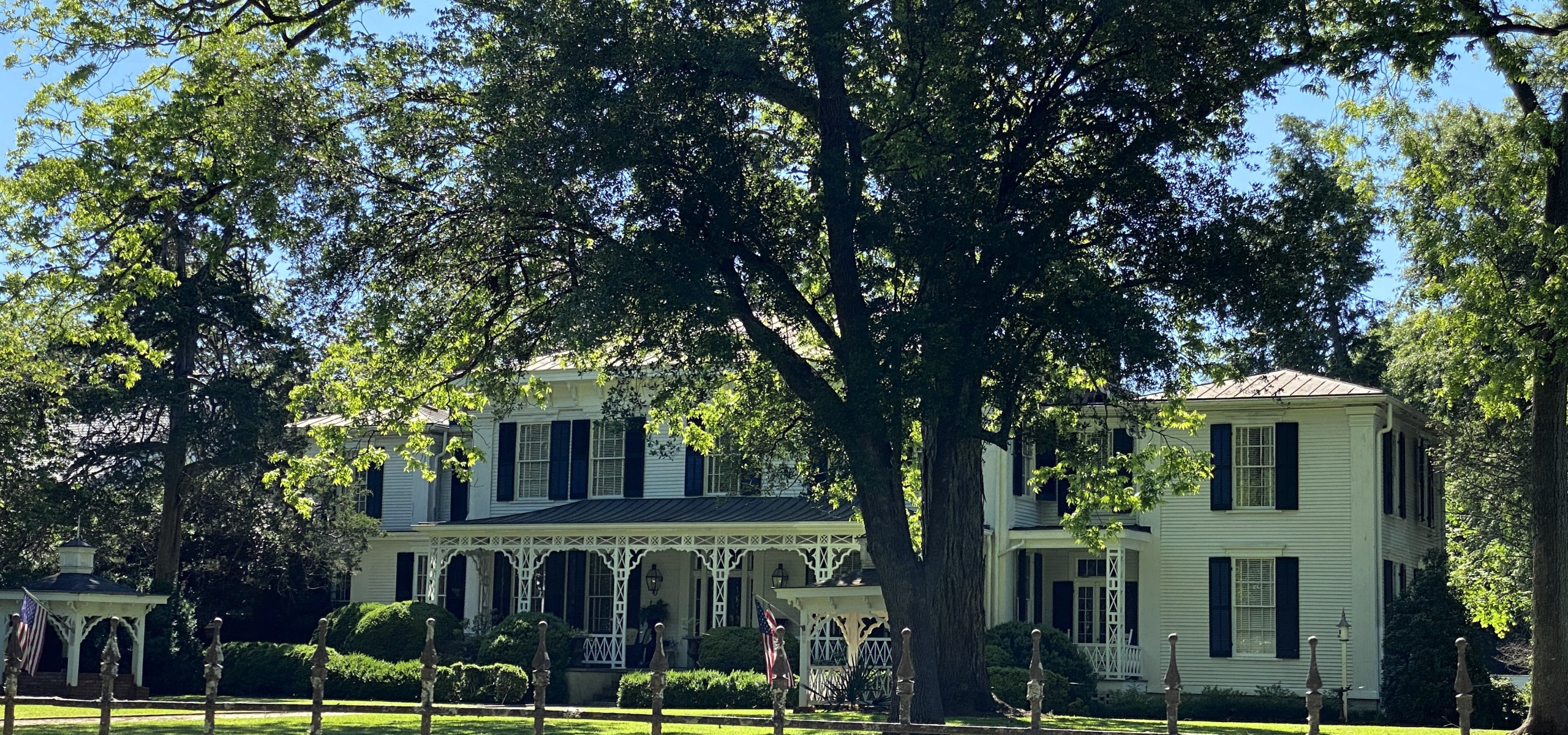

Want to break up a driving trip in the SE United States? A stop in Madison, Georgia is a refreshing break and a nice alternative to nearby Atlanta.
Dating from 1809, Madison is one of Georgia’s largest and oldest historic districts and is listed in the National Register of Historic Places. Frequently described as one of the South’s “prettiest” towns, and has a lost-in-time, slow vibe that can indeed transport you to the past.
It secured a place in history by being on the stagecoach route between Charleston and New Orleans and spared burning by Union General Sherman during the Civil War. Although a town filled with homes of wealthy plantation owners would’ve seemed ripe for destruction, Mayor Joshua Hill was a strong supporter of the Union. Serving in the House of Representatives, he had ties to Sherman’s brother and during the War, he made a gentleman’s agreement with Sherman’s detachment to spare the town. Hill later served in the US Senate. Of note, despite Hill’s Unionist leanings, much of the community, and even members of his own family, were committed Confederates.
Close to 100 antebellum homes have been restored and are easy to see with self-guided driving or walking tours. Like its nearby neighbor Covington, the town has served as backdrop for many productions (American Made, Goosebumps, I’ll Fly Away) and has a cute downtown with restaurants, local shops, and antique stores (which sadly, I didn’t have time to visit).
Explore Georgia has a great 28-stop self-guided tour, packed with info, that’s easy to use through a smartphone or tablet. One warning, it would be a loooong walk. Since we visited during the dog days of summer – we drove.
A fun fact – Oliver Hardy, of Laurel and Hardy fame, lived here most of the first eight years of his life, while his mother ran a boarding house.
Many of the private homes are surrounded by lush trees and shrubs making it difficult to get great pics, so you can check out the links above for some older shots with less landscaping and wonderful historic prints. Here are a few highlights from our tour:


We stayed at the James Madison Inn. A new building combining residences with hotel rooms. It was nice, comfortable, and very conveniently located; with breakfast included.


