

Today we explored the Lake Myvatn area of North Iceland. In the space of just a few hours we saw craters, a massive geothermal area, a city of lava formations, a peek into the Grotagia Thermal Cave, a string of pseudocraters, and of course, the 14 square mile lake.
Located about 30 minutes from our base of Husavik, the landscape on the way was rolling hills surrounded by pastures. Once we reached the Myvtan area we headed to the Namafjall Geothermal Area. Much larger than the area we saw in the Golden Circle, this massive site is filled with steaming vents and bubbling mud pots. The smell of hydrogen sulfide fumes is pretty overwhelming, but when you put together the smell, the sound of the rapidly bubbling liquid, and the otherwise barren, sandy moonscape appearance you feel like you are on a set of a sci-fi movie.


From there we ventured a bit further down the road past the Krafla Geothermal Power Plant to see the Viti (Hell) Crater. Formed during eruptions in the 1720s, the crater is filled with hot water. Not as colorful as our last crater in the Golden Circle, but nevertheless it cut an imposing figure.
Next stop, the Grjotagia Thermal Cave where one of the Game of Thrones most memorable scenes took place. The love scene between John Snow and Ygritte. It’s a smaller space than I would’ve guessed and it must’ve been complicated to get all the necessary filming equipment on location. When we visited a bunch of people were crammed in the cave taking selfies and after going part way in, I decided not to hang around. As a result, I did not get a great pic. Above the cave, you can follow the path to the top and view a really long fissure created by a buckled ridge of lava. On private land, this site is not always open to the public.


Getting closer to the lake, we started to see the famous midges, the flying (non-biting) insects that give the lake its name, Myvatn (midges). We had brought along head nets and they did come in handy as we wandered around the Dimmuborgir Lava Formations. Aptly named “Dark Castles,” the saga tells us this is where the devil landed when he was cast out of heaven. I can believe it. The huge formations were actually created underwater when magma leaked up making all sorts of dramatic shapes. Several trails are laid out through the sensitive terrain and it’s easy to see imagery and figures (think trolls) in the rocks. I didn’t realize til later, this was the site of Mance Rayder’s army camp in the Game of Thrones Season 3. Honestly, this is not a Game of Thrones Tour, I just keep bumping into sites and realizing how much they filmed here.


The midges are pretty bad and swarm this time of year. It makes hanging around the lake pretty undesirable. Since boating is restricted, the lake appears quiet, calm, and otherwise peaceful (if it weren’t for the midges). Those bugs do have their purpose, they help make the area prime breeding ground for about 115 species of birds that live and migrate through. If fact, during our lunch stop in Reykjahlid we ran into a group that was on a bird watching tour, no doubt they would be checking out the nearby Sigurgeir’s Bird Museum.
The Skutustadir Pseudocraters provided our final stop in this region. You can see the crater-like mounds in a huge area. They were formed when giant bubbles formed in molten lava and then burst when steam rose to the top. This was a type of landscape new to us, something we’d never seen.


Many draw comparisons between this area and Yellowstone National Park. Other than the fact they both have geothermal fields, to me, they seem distinctly different. I give the Lake Myvatn area due respect for being its own unique spot on earth.


We made sure to visit Husavik since it’s the center of Iceland’s whale watching business. The cute town is nestled around the harbor. We got into oversized waterproofed jumpsuits and hunkered down for the ride north into Skjálfandi Bay, a designated whale sanctuary. It was freezing. The company – North Sailing uses authentic oak schooners as part of its whale watching fleet, ours was the Saeborg. They had called us earlier in the day to let us know the weather was expected to take a turn for the worse and suggested we take an earlier excursion than planned. We did, thankfully. Later would’ve been more windy and even colder.

Many types of whales frequent these seas, and we saw four humpback whales and spent time following and watching them. The highlight was an unusual grouping of three of these usually solitary animals – but two of the three were a mother and baby – so cool to see. The whales’ journey to the colder waters for feeding and I have to say, trips in Alaska are definitely more comfortable. On this afternoon, we welcomed the mugs of hot chocolate they passed out on the trip back in (the cinnamon bun was cold, but I ate it anyway)!


Godafoss, known as the Waterfall of the Gods. It owes this significant name thanks to another Icelandic saga. The legend explains a farmer was chosen to decide if Iceland would convert to Christianity (a cause Norway was championing). He decided yes and threw all his carved pagan statues into this fall – ergo the name, Waterfall of the Gods.
We stopped off here on our route between Siglo and Husavik. Another beautiful day, blessed with good, chilly weather. Only 40′ high, the falls stretch 100 yards wide. Viewing areas are nicely positioned and boardwalks with barriers make for comfortable walking. There are two perspectives for viewing and visitors can either drive between the parking lots or cross on the old road. We chose to stretch our legs and views in both directions from the old road are shown below.


What a glorious day this was. We were so fortunate the wind died down, sun came out and the temps rose to the upper 40s. In the morning we let the chill warm up with a visit to the award-winning Herring Museum. The museum occupies three buildings and is very interesting – I had no idea about the history or the products produced (fish, oil, and fish-meal) until today.


Siglo, once known as the “herring capital” was the center of this fishing enterprise and had a significant role in the economy and development of Iceland. Ultimately, contributing in a major way to Iceland becoming independent from Denmark. Like towns in the days of the American Gold Rush, it was a booming, happening place to seek work and good fortune. The industry survived a major avalanche and fire that destroyed two factories, yet continued to thrive for decades. But herring are a migratory fish – and migrate they did. By the mid-1960s the fish were gone and so was most of the population. Since then, the town has reinvented itself as a tourism destination, with heliskiing during winter months and visitors like us in the summer.

We wandered around the sleepy little town with its brightly painted assortment of 1930s vintage buildings. Many storefronts were empty, likely due to the pandemic’s impact on tourism, and others were closed on Saturdays. A crowded bakery caught our attention and served as a sweet spot for a casual, yummy lunch.
Now we needed to walk off a few of the calories consumed with our lunch, so we headed out for a short drive to a nearby forest. You don’t see trees in Iceland thanks to aggressive cutting and burning of timber by early Viking settlers 1,000 years ago. Finding even a small forest was a bonus. We knew the Leyningsfoss Waterfall could be viewed from a forest trail, and after getting some slightly vague instructions, we headed out to find it.

The forest also bordered the area’s 9-hole golf course. Originally, we had scheduled a round for today, but the course decided not to open yet (we heard the weather had been colder, later than usual). We still wanted to check it out on our way to our hunt for the falls.
A fairly steep and slippery hike took us up to a beautiful vista of falls across the valley and eventually got us to a very peaceful setting (with a bench!) where we could see Leyningsfoss and savor the crisp, beautiful afternoon surrounded by pine trees, listening to the roar of the falls and chirping of the birds.

Eventually we forced ourselves up, finished our walk in the woods, and drove back to town in search of gas to be ready for the next day. We have had some adventures getting gas. You really do have to use a card with a pin number, and we were prepared for that, but only our credit card (with pin) works, not the more cost-efficient debit card. The whole system is tricky, stations are quite dispersed, and sometimes not all the pumps work. Our car is a hybrid, but we have not yet figured out where it could be charged.
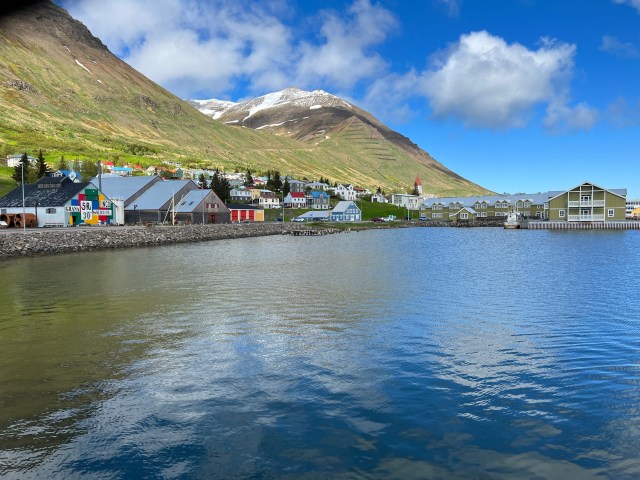
The Siglo Hotel is a lovely place to stay and our views can’t be beat. Finished off the day on-site with a visit to the bar and a lovely dinner. A lot of folks can be seen heading outdoors to the hot pools and then sitting around in swimsuits . . . not for this Miami girl! I’m content to lounge in our room’s window seat and just stare at the view.


