

 Santa Cruz & Bartolome Islands: Tidal Pools & Vistas
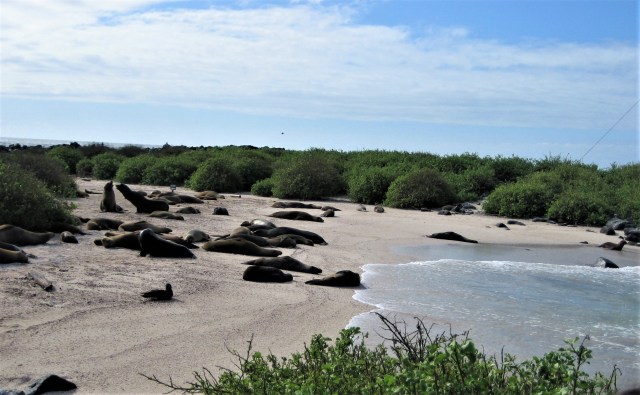
A landing at Bachas Beach on Santa Cruz Island was our first excursion on day 4 of our week-long trip with Celebrity Xpedition. We were on the beautiful shore for about two hours at low tide and able to experience the tidal pools among the lava rock, with pure and fine white sand. There were small fish everywhere, a lone pufferfish, crabs, marine iguanas sneezing salt, sea lions, blue herons, pelicans, lava herons, and one flamingo. It was lovely and hot, hot, hot.
 I struggled to stay awake during the lunchtime lecture on sharks before we re-grouped and headed to Bartolome Island for a hike to the archipelago’s highest point, 374’ with postcard vistas, and a boardwalk with 358 steps. It was how I envision the moon, brown sand, black lava, and red rocks (or maybe Mars). Back at the beach we put on our wetsuits and had another snorkel adventure, this time seeing some really beautiful, colorful fish that I could not identify. That night we celebrated crossing the equator.
Viewing the stars in the night sky from a boat in the middle of any ocean is something to behold. The captain turned off all the ship’s lights so we could take it all in on this perfectly clear night.

Isabella Island: Jungle Walk & Coastal Cruise
 We cruised most of the night heading around the north portion of Isabella Island to Espinoza Point on day 5. Isabella has five dormant volcanos and is shaped like a seahorse, Espinoza in the middle. We walked in hot, humid, jungle-like conditions, and for the first time had to use bug spray. We searched unsuccessfully for land turtles but did see plenty of iguanas and birds. I spent some time trying to get good photos (most unsuccessfully) of the finches, butterflies, and beautiful yellow flowers of the cactus plants. The naturalist told us this lush vegetation will be gone very soon as the dry season takes hold.
On the mother-ship for an Ecuadorian lunch, we cruised and looked for dolphins and whales, enjoying a pod of dolphins at play. Late in the day, we took another panga ride, and our group opted to look for sea turtles rather than hike on the island. We rode around the coast of Fernandina finding a few turtles, penguins, flightless cormorants (with wings 1/3 the size needed to fly), and many more birds. Dinner was served al fresco and a guest (who was a professional opera singer) was prevailed upon to sing. We listened to a magical, acapella rendition from Porgy & Bess.


Santiago Island: Pristine Grotto & Fur Seals
My new favorite was on day 6, at James Bay on Santiago Island – stunning!
We walked across the island in silence and just took in the sounds, at one-point walking right by a hawk just staring as we passed. The best was yet to come when we got to the lava flow on the other side of the island, with its tidal ponds, lava bridges, and grotto. And that’s where we found the fur seals, including pups. They were so adorable! Along with our usual array of birds and marine life, we saw oystercatchers, and, in the crystal-clear water of the grotto, there were beautiful tiny redfish and a sea turtle passing through. I could’ve stayed with the fur seals all day.
Back around the island on a black sand beach, we went snorkeling and I saw the most beautiful, blue starfish I’d ever seen, as well as pufferfish, parrotfish, anemones, and so many more I cannot ID. Others saw a white tip shark, and again, I was thankfully ignorant of its presence.
 Back out after lunch, we chose a low-intensity activity and went ashore on the beach at Dragon Hill for a walk. The naturalist led us through a cactus forest to some brackish ponds where we saw pin-tail ducks and black-neck stilts, no flamingos. We went snorkeling in an area known to have lots of baby sharks and rays, but the tide was coming in and they were not around, so it turned into a nice refreshing swim. The lava rocks are super slippery and difficult to climb. Sadly, this was our last snorkel of the trip.

Santa Cruz Island: Lonesome George
Santa Cruz Island’s cute town of Puerto Ayora is the main center of human population (12,000) in the Islands and home to the Charles Darwin Research Station. When we visited it was also home to the most famous land tortoise in the world, Lonesome George. The highlight was getting to see Lonesome George (who has since passed at the approximate age of 100) and seeing two of the giant males trying to mate (they got it woefully wrong). Overall, I was a bit disappointed since I would’ve liked to know more about the scientific work being done throughout the Archipelago.
 In the afternoon we went into the highland to search for giant tortoises in the wild. It felt more like Costa Rica to me, very tropical with papayas, bananas, and palms and temps a bit cooler with very fresh air. We only found three tortoises, one huge and a smaller one our naturalist was very excited about. Estimated to be about 10-years-old, he had never found one so young. We topped off the excursion with a not-so-great encounter with some red ants, and a fun visit to a huge lava tunnel.
We docked overnight on this day 7, near Baltra Island to be close to the airport for the plane trip out the next morning.
Planning Tips:
- Be sure to take a hat and ample sunscreen
- You are on the equator and the sun will have more impact (even for us Miamians), so keep hydrated
- Most ships provide wet suits, flippers, masks, snorkels, and walking sticks. I took my own mask/snorkel.
- Eat like a local. The seafood is great, meats not so much since most food is sourced locally from the islands.
- Make this trip while you are young enough to really experience all the Islands have to offer. Those 70+ on our ship were wishing they had visited at least 10 years prior. It would be a great family trip with kids.
- Quito (9,500’ high) is a beautiful colonial city to visit and spend a few days on either side of your trip; there are some great restaurants here. Be sure to travel into the mountainous countryside; the Otavalo Market and Laguna Cuicocha area are two spots not to be missed.
- Read Charles Darwin’s iconic “The Beak of the Finch” to understand his theories and why the Galapagos are so important


I took advantage of empty hours during the pandemic to create some new content about trips I took in the past but never posted. Now that people are starting to travel again, it’s time to share.

Spring break a lifetime ago, my great college friend Meta went to the Galapagos Islands. Until then, and for years after, I never knew anyone else who had the privilege of visiting this incredible area of the world. Meta went on the become a veterinarian and I became a professional communicator with a passion for travel. It took me many years to have the time and the resources to visit Ecuador’s Galapagos Islands.
Meta had vividly described snorkeling in the Devil’s Crater and her vivid description stuck with me for years. Sadly, when we visited, Devil’s Crater was off-limits to everyone, due to over-visitation. Thankfully, the Ecuadorian government monitors the area closely and is trying to protect and preserve this most valuable national commodity. The government will only allow Ecuadorian registered vessels to ply the waters, and insists on a native crew from the Islands if at all possible and, when not, from mainland Ecuador. On our Celebrity Xpedition ship, only the captain and the ship’s physician were not from the islands.
How and When to Go
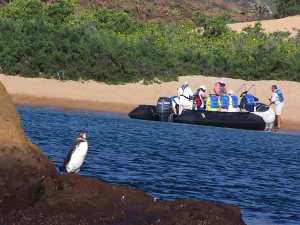 Obviously, you need to see the islands and move among them by boat. The government tightly regulates ship’s routes and can change them at any time. They did a good job of keeping the various ships away from one another. There are a large variety of vessels to choose from with just about every major cruise and tour company now offering trips. I had two criteria that influenced my decision. One, I wanted a ship with an onboard physician. You are pretty far from medical care otherwise. Two, I wanted several naturalists on board. Our ship had five for less than 100 passengers. Having multiple naturalists guaranteed different interpretations and personalities, and I liked hedging our bets by having variety. Visitors land on the islands in rubber inflatable boats called pangas, each could take about 12 guests, a pilot, and a naturalist.
The daily routine involves morning and afternoon adventures either snorkeling, walking, or seeing sites; refreshments upon return, meals onboard, and a cocktail-hour session with the naturalists followed by dinner.
Choosing to go in May, at the end of the rainy season, we knew the sea lion pups would be at their most playful and we would still see a bit of greenery.
We flew into the Islands from Quito through Guayaquil, landing on Baltra. Our 4-month old jet was three hours late due to difficulty re-locking the luggage hatch, but since we had stopped in Guayaquil to pick up crew, we knew the ship would be waiting. On arrival, we were immediately off on our first of many panga rides to board our home-away-from-home for the next week.


North Seymour Island: Boobies & Frigates
We wasted no time and made a late afternoon stop on North Seymour Island for a fabulous mile-long hike among the nesting and mating Blue Footed Boobies and puffed-up Frigates. It all felt very prehistoric as we scaled volcanic rocks after landing onshore. We walked across coral sands and red-tinted soil immediately spotting fat sea lions, bright red Sally Lightfoot crabs, and salt-encrusted marine iguanas. The rainy season had been much wetter than usual and vegetation was still pretty green. It was incredible.


Kicker Rock & Espanola Island: Dramatic Formations
On day two we had an extra excursion, heading out to Kicker Rock at sunrise. Birds, sea turtles, dolphins, and sharks were in abundance. The experience was spectacular. Back on board, we headed to San Cristobal for a visit to the capital of the Galapagos, Puerto Baquerizo Moreno, and the Interpretation Center with information about the area’s history, environment, and diminishing resources. As we explored the small downtown, we enjoyed the antics of the sea lions scattered along the rocky beach. It was true theater.
 Onboard again we learned about geology and were issued our wetsuits and gear before heading to Espanola Island where I chose to go on a longer more rigorous walk observing Darwin’s Finches, Lava Lizards, Nasca Boobies, and (a big highlight) the Galapagos Albatross. The sights just kept getting better, and we were lucky to see the mating ritual of the Nasca Boobies which was quite a dance with lots of beak-tapping.

 Walking along the cliff of the rocky coast, the dark rocks capped with massive amounts of guano looked like icing had been poured on them. The rocky terrain was set off against incredibly blue water, pounding waves, white caps, sea spray, and scrubby vegetation making for a strikingly beautiful landscape. And then, add the Albatross sitting around, Boobies socializing, Frigates cruising above, and a lone hawk watching . . .
Finally, to re-board our pangas we had to carefully pick our way around marine iguanas, crabs, and sea lions everywhere we looked.
Back on the Celebrity ship, they dropped cameras underwater for some interesting views of sea life below the surface. Even on the surface, there was drama, and at one point we were watching a baby turtle, followed by a pelican, being followed by a shark.


Floreana Island & Mystery Bay: Snorkeling & Swimming with Sea Lions
We’d seen so much already and it was only day 3, as we made the short cruise to Floreana Island. It was here I learned we would not be able to snorkel at Devil’s Crater which was very enticingly in view from our cabin. But no worries since we opted for a wet landing at Cormorant Point where we walked to see wild flamingos and snorkeled from the pretty little beach. It was hard not to just watch the mom and baby sea lion in the water, but when I could finally pull my eyes away, the underwater lava rocks and fish were a treat to see. Several in our group saw sharks, and I’m glad to say I did not.


Our first sighting of the famous Galapagos Penguins was in the panga on our way back to the ship. The colder Humboldt Current from Antarctica crosses this region bringing all sorts of nutrients and wildlife such as the penguins. This colder water is why you need a wet suit to swim, snorkel, and dive here even though you are by the equator.
 After lunch, we went for a deep-water snorkel trip at Mystery Bay to swim with sea lions, large greenback sea turtles, and rays. It was exhilarating and exhausting. Later in the day, we hiked to the Baroness Lookout on the Bay and although there were great views, it was the panga ride that was most special. We saw lots of sea lion pups, so many types of birds, including pelicans, as well as rays, turtles, and blacktip sharks. We were back on board the mother-ship at 6 PM, tired but happy.
Part 2 covers adventures in Santiago, Santa Cruz, Isabella, and Bartolome Islands.
A note about the photos: I did not have a great camera on this trip and our friend’s camera battery went dead almost as soon as we got to the islands. I don’t know if it was the salty conditions, but several of my camera’s SD cards were corrupted; fortunately, after a lot of anxiety, some of the pictures were able to be professionally recovered. Even more fortunately, the naturalists surprised us all with a CD of shots they had taken throughout our trip. As a result, many of the pics here are courtesy of the Celebrity naturalist team. BTW, the inexpensive, disposable underwater camera I bought wasn’t worth anything, it was far better to just enjoy the experience.


A few years back I had an assignment from Dade Heritage Trust to write an article about the area’s Heritage Parks. There are seven. In spite of the decades I had lived here, having visited most of them, I did not know their backstories or that we even had designated Heritage Parks. It was an exciting discovery.
Now I have delved a bit deeper into the details of each site and put together a driving tour so anyone, visitor or local, can easily find these very special parks. You can get to my tour of Miami-Dade County’s 7 Heritage Parks just by clicking the tour name. Even if you can’t visit in person, this virtual tour will take you from Miami Beach’s Haulover Beach Park to Greynolds Park in North Miami Beach, out to Key Biscayne and the expansive Crandon Park, to Coral Gables and Matheson Hammock Park, Miami’s Deering Estate, farther south to the Fruit & Spice Park in Redland and, finally to Homestead’s Bayfront Park.
If you are not familiar with Clio Tours you should check out this great resource for history and culture. You can find all sorts of walking, driving, and biking tours on this free site. It is supported through a foundation and has a lot of academic input, but also thrives on community participation. I have done my entries in the name of a preservation group close to my heart – The (Miami) Villagers.


Our little, youngest Baby J sends good tidings to all! Hope Santa is good to you.


